Thriv Blog
Agentic Commerce Explained: Why Human Operators Still Drive Revenue
A practical breakdown of agentic commerce in 2026: what should run autonomously, where human operators must stay in control, and how this affects conversion, margin, and retention.
S.N.Prakash | April 9, 2026 | 8 min
Agentic commerce is moving fast, but the operating model is still misunderstood. Teams see better speed in discovery, recommendation, and checkout, then assume human involvement should shrink everywhere. In real revenue systems, that is usually where quality breaks.
The useful question is not whether AI agents can execute transactions. They can. The useful question is where autonomous action should stop and operator judgment should take over.
Customers do not measure your commerce system by how autonomous it is. They measure it by whether decisions feel fair, outcomes are reliable, and exceptions are handled intelligently when policy and context collide.
That is exactly why human operators still drive revenue in agentic commerce. Not because automation failed, but because commercial edge cases carry consequence.
Where Agentic Commerce Works Best
There are clear zones where agentic workflows perform extremely well: repeat ordering, familiar product bundles, straightforward procurement steps, and policy-compliant offers. In those paths, AI can cut friction, reduce delay, and improve conversion consistency.
This is the part most teams are already seeing. Response latency drops. Recommendation quality improves. Customers move faster through obvious journeys. These are real gains and should be preserved.
But faster pathing is not the full revenue system. The difficult part sits in the non-obvious decisions: discount exceptions, disputed invoices, trust-sensitive refunds, custom terms for strategic accounts, and procurement situations where strict policy may be technically correct but commercially wrong.
Why Human Operators Still Matter
In these edge cases, the decision is not just transactional. It is relational and financial at the same time. One rigid decision can protect short-term policy yet damage long-term account value. One careless exception can close a deal yet quietly erode pricing discipline for future deals.
Human operators are the control layer for this tradeoff. They balance policy with context. They evaluate whether a case is an exception worth granting or a precedent that creates leakage. They protect both trust and margin in the same moment.
That is not anti-AI. It is proper system design.
A Practical Decision Model
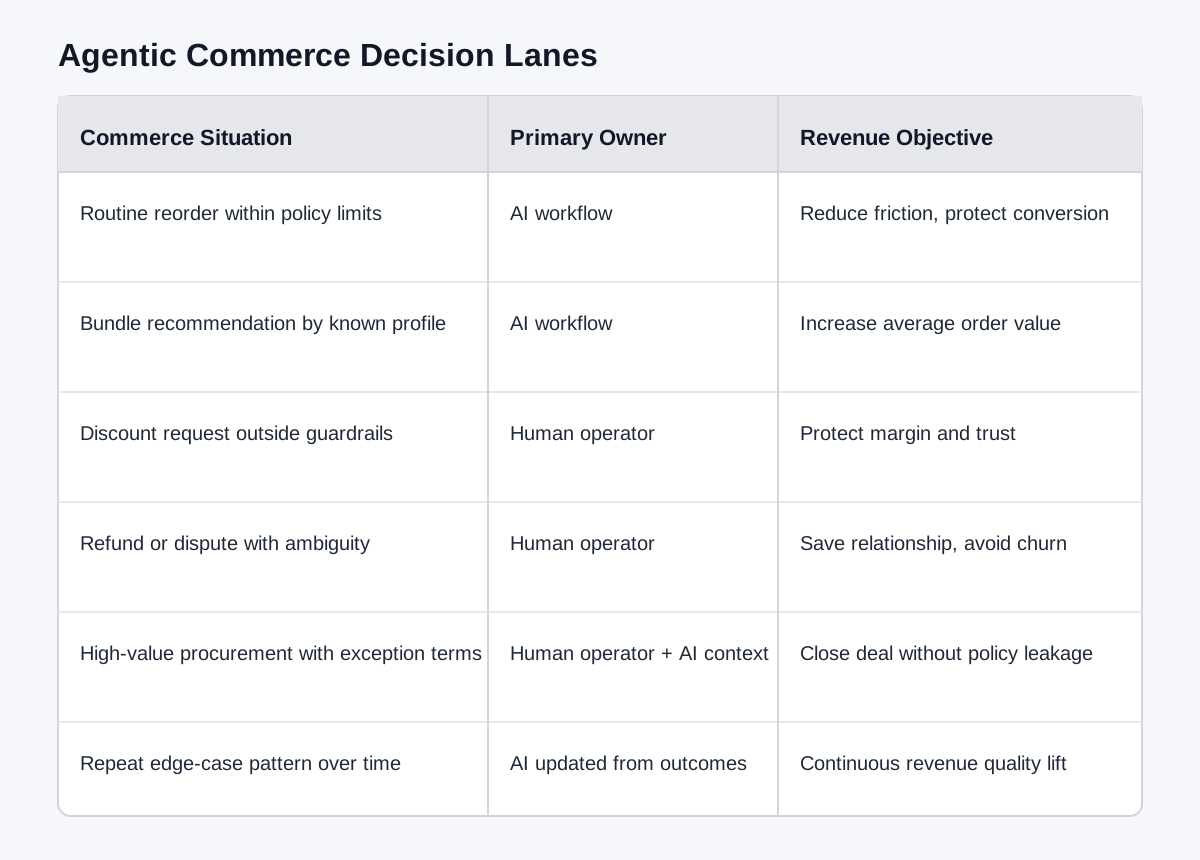
A strong agentic commerce stack separates execution from judgment. AI handles high-volume policy-safe flows. Humans own high-consequence commercial decisions. Then outcomes feed back into the system so autonomous lanes improve over time.
The Mistake Most Teams Make
The common mistake is optimizing autonomy rate as the north star. That metric rewards containment and speed but often ignores outcome quality. You can get highly autonomous flows with higher reversal rates, lower trust, and noisier margin outcomes.
The better north star is decision quality at revenue-critical moments. Organizations can focus on designing a stronger decision layer than only accelerating first action. This avoids polished automation with weak commercial outcomes.
When that layer is combined with feedback loops and dynamic learning, the system gets better where it matters: fewer avoidable escalations, smarter exceptions, and better account-level retention.
How to Implement Without Slowing Down
The practical implementation is straightforward. Define your autonomous lanes clearly. Define your human-only lanes explicitly. Equip operators with full context instead of fragmented tickets. Record final decisions with reason codes. Feed those patterns back into model prompts and policy logic on a regular cadence.
That structure preserves speed in routine flows while improving quality in high-impact flows. It also makes governance easier because every decision type has clear ownership and measurable outcomes.
In other words: autonomy where execution is obvious, human ownership where commercial judgment is required.
Final Take
Agentic commerce is not AI versus humans. It is a layered operating model. AI should handle repeatable execution at scale. Human operators should control consequence-heavy decisions that shape trust, margin, and long-term revenue health.
Teams that design this boundary well will outperform teams that chase autonomy as an end in itself.
That is the practical revenue standard for agentic commerce in 2026.