Thriv Blog
AI in Customer Support: Speed Yes, Quality Depends on Decision Design
A practical look at AI in customer support: what AI should automate, what humans should still decide, and how to design a decision layer that protects trust and retention.
S.N.Prakash | April 9, 2026 | 9 min
I recently came across this X post that stayed with me.
Most support interactions are not pleasant, but something like this is memorable.
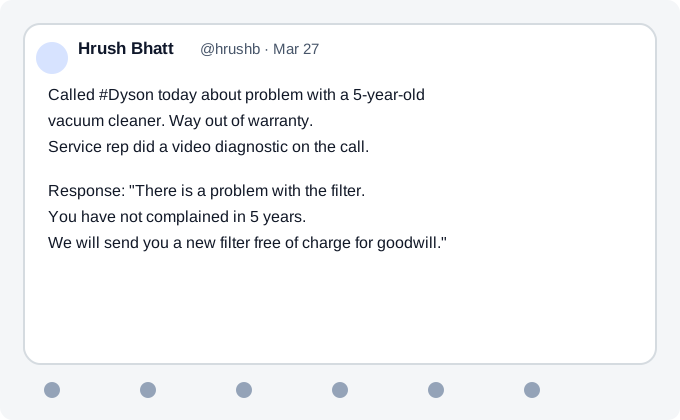
It also signals something operationally important. Dyson appears to have given the support executive enough room to apply judgment, instead of forcing a rigid "let me escalate this to my manager" loop for every exception. That matters because it is exactly where many support systems break: the process is clean, the script is correct, but the outcome still feels wrong.
So the question is not whether AI belongs in customer support. It clearly does. The real question is how AI-assisted support can deliver this level of quality without stripping out human judgment.
Where AI Helps, and Where It Should Not Decide Alone
AI is excellent at speed work. It can classify incoming issues, summarize prior conversations, pull order and warranty history, identify known product failures, suggest response paths, and remove repetition for both the customer and the agent. For routine cases, that is a direct quality improvement because speed and consistency are exactly what the customer needs.
But customers do not remember support for clean ticket routing. They remember support when a difficult case ends with a sensible outcome. That is the layer where judgment still matters: policy exceptions, trust-sensitive issues, frustrated long-term customers, and situations where strict compliance creates a bad business result.
In short: AI should remove friction, but humans should still own consequence.
The model below is the simplest way to design that balance. It keeps AI in front where speed is valuable, and keeps human ownership where decision quality has business impact.
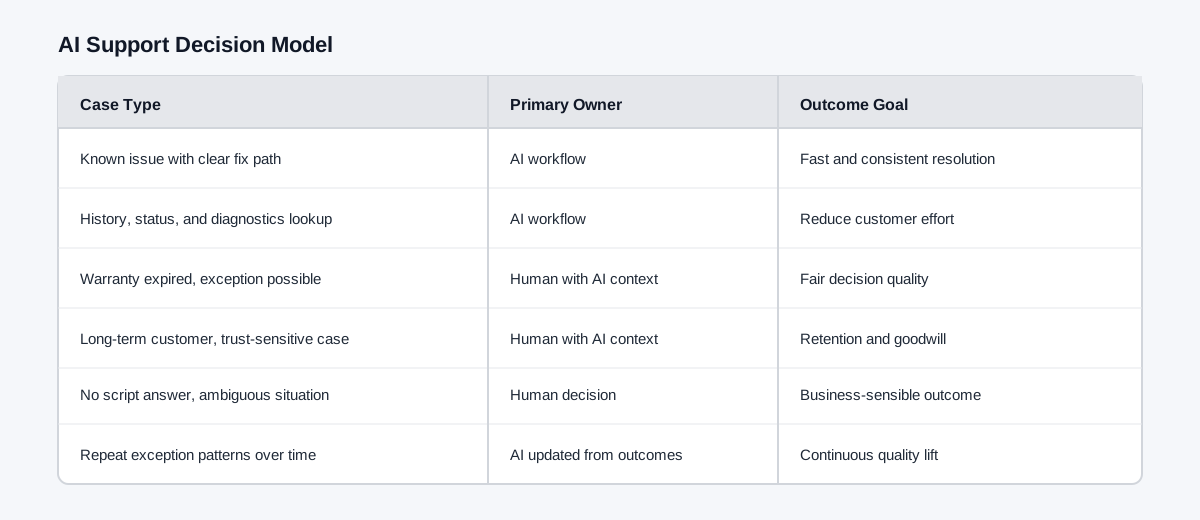
Why This Matters More Than "Automation Rate"
Many organizations still measure support transformation using automation metrics only: bot containment, average handling time, and first response speed. Those metrics are useful, but incomplete. A polished response delivered quickly is still a poor experience if the final decision feels unfair.
Organizations can focus on designing a better decision layer than only the speed of first response. This can avoid polished responses with weak outcomes. Combined with a feedback loop and dynamic learning from human decisions, this is what actually improves support quality over time.
When this is done well, the customer does not repeat themselves, the agent receives full context without rework, and the business can make fair exceptions without losing control of policy. That is the difference between operational efficiency and real service quality.
What Changes in Team Design
When teams adopt this model, staffing and governance also change. Agents are no longer treated as script executors. They become decision operators with clear guardrails. AI becomes a context engine, not the final authority in every case.
This also improves coaching. Instead of only reviewing call tone and macro usage, leaders can review decision quality: was this exception sensible, consistent with business policy, and worth the goodwill outcome it created? Those decisions can then be fed back into AI prompts and policy rules, so the system becomes more precise over time instead of simply faster.
The practical effect is that support becomes less reactive and more strategic. It reduces avoidable churn, protects brand trust, and lowers repeat-contact volume because customers feel resolved, not just processed.
Final Take
AI can absolutely make support faster. It can also make support cleaner, more consistent, and less repetitive. But quality still depends on whether the system knows when a human should decide.
The future of support is not AI versus human. It is AI giving humans the right context at the right time, so decisions are faster and better.
That is the performance standard that matters now.