Thriv Blog
The Price of Intermediation
How digital markets reduced old brokers and gatekeepers while creating new forms of intermediation, visibility costs, and platform dependence.
S.N.Prakash | March 25, 2026 | 6 min
What Brokers, Gatekeepers, and Middle Layers Solved
Before technology reduced layers, access often depended on someone in the middle.
A taxi driver depended on dispatch and licensing. A business hiring talent depended on recruiters, agencies, or referrals. A seller depended on distributors, retailers, or shelf space. These middle layers existed because they solved discovery, screening, coordination, trust, and access.
But they also slowed the process, stayed local, remained opaque, added cost, and over time became unnecessary hurdles in many parts of the market.
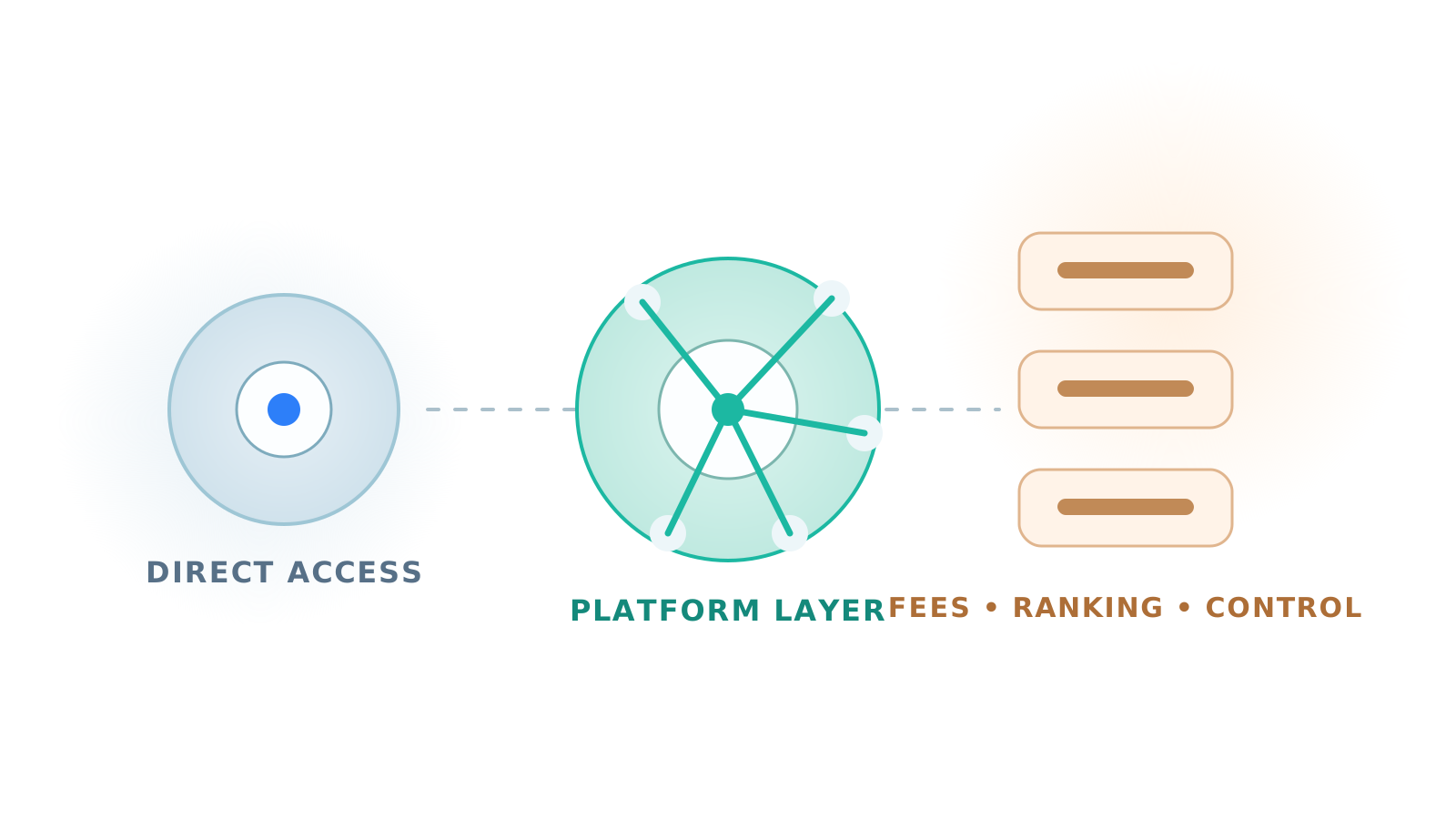
How Digital Markets Cut the Old Layers
Technology helped remove or reduce layers.
Search moved online. Reviews moved online. Messaging moved online. Payments moved online. Matching moved online. A customer no longer had to depend only on a local broker, operator, or referral chain. A provider no longer had to wait for someone to open the door.
Uber did this in transport. Amazon did it in commerce. Upwork and Fiverr did it in freelance work. LinkedIn did it in professional discovery. The pattern is the same: reduce friction, widen access, speed up matching.
What Customers Gained
Customers gained speed, easier comparison, wider choice, better visibility, and often better value for the same spend.
A person booking a ride could see availability and price immediately. A buyer on Amazon could compare products, reviews, delivery options, and sellers in one place. Amazon says independent sellers now account for more than 60 percent of sales in its store, and that those sellers have generated more than $2.5 trillion in sales over 25 years. That shows how much visible supply moved into one searchable marketplace.
In work markets, a business could compare more providers, more locations, and more price points without going through the same old channels. Search cost fell. Waiting time fell. Efficiency improved.
What Businesses and Providers Gained
Businesses and providers grew.
A smaller business could reach more customers without building the same physical or relationship infrastructure older businesses needed. A provider could reach demand beyond local geography. A specialist could test the market faster. A lean business could grow without carrying the same fixed structure.
The scale of these markets shows that clearly. Upwork reported $4.0 billion in gross services volume in 2024 and 832,000 active clients. Fiverr reported $391.5 million in 2024 revenue with a 27.6 percent marketplace take rate. These are growth systems, not side channels.
What Problems Still Remain
Removing old layers did not remove all problems.
Trust is still a problem. Quality is still a problem. Fit is still a problem. Accountability is still a problem. A large open market gives more choice, but also more noise.
Some older frustrations changed form. High commissions and platform fees remain a real issue. Ranking logic is often not transparent. Reviews can be incomplete, manipulated, or too blunt. Personalised service can weaken when interaction is pushed into a system. And when something goes wrong, responsibility can become fragmented across seller, provider, marketplace, and platform rules.
So the market became easier to enter, but not automatically fairer, clearer, or more personal.
What New Trade-offs Came With It
The new system reduced old barriers, but created new dependence.
Once the market sits inside a digital system, that system shapes who gets seen, who gets trusted, and who gets chosen. Commissions, service fees, subscriptions, promoted placement, and advertising turn access itself into a business model.
That is visible in current numbers. Upwork said ads and monetization revenue rose 51 percent in 2024 and Freelancer Plus subscription revenue rose 58 percent. Fiverr's 2024 marketplace take rate was 27.6 percent. That means the middle layer is not only matching demand and supply. It is monetizing visibility, attention, and flow.
There is another trade-off. The system looks more open, but it can become harder to see how it is really working. The EU's Platform Work Directive, adopted in 2024, directly addressed employment classification, algorithmic management, transparency, and human oversight. That by itself shows where the pressure has moved.
Old gatekeepers weakened. New digital gatekeepers emerged.
How Customers Are Impacted Now
Customers still benefit from convenience, reach, and lower search cost. That part is real.
But customers now operate in a more crowded and system-shaped market. More choice can mean weaker clarity. Promoted options are not always the best-fit options. Ratings and badges help, but they can also shape judgment before the customer has assessed quality independently.
There is also a transparency issue. A proposed California class action complaint filed in 2025 alleges Fiverr showed one price repeatedly and then added a mandatory service fee near checkout. That remains an allegation, not a finding, but it captures a real customer-side issue in digital markets: the path can look simple until the full cost appears.
So customers gain access and efficiency, but not always certainty, transparency, or the best fit.
How Businesses and Providers Are Impacted Now
Businesses and providers gained reach, but they also entered a more exposed market.
A new entrant can disrupt your position quickly. A better-priced competitor, a better-ranked profile, stronger reviews, faster response times, or more paid visibility can shift demand away from you fast. The market is more open, but position is less secure.
For providers, the issue is not only income. It is discoverability, fees, ranking, and dependence on rules they do not control. The FTC's 2024 action against Arise is an extreme example, but a useful one: the agency alleged misleading earnings claims, mandatory fees, training costs, and economics far below the headline promise. That shows how digital access can be sold as opportunity while the underlying economics can look very different.
For businesses, the issue is not only growth. It is staying visible, defending position, and competing in a market where barriers are lower and turnover is faster.
What This Means for the Market Now
The deeper story is not that middle layers disappeared. It is that they changed form.
Technology reduced some old brokers, gatekeepers, and layers. That created real gains for customers, businesses, and providers. Markets became faster, broader, and more accessible. But the same shift also created new dependencies, new monetization layers, and new questions about control.
That is what intermediation means here. Not only someone taking a fee, but whoever sits between demand and supply, shapes access, and earns from the flow.
For Thriv, the practical answer is to keep the path direct: let people move from reading to action with clear routes to Find Experts, Browse Projects, and pricing instead of adding more hidden layers.
The real question now is not whether intermediation exists. It always does in some form. The real question is which layer adds value, which layer extracts value, and how much control should sit in the middle once connection becomes easier.